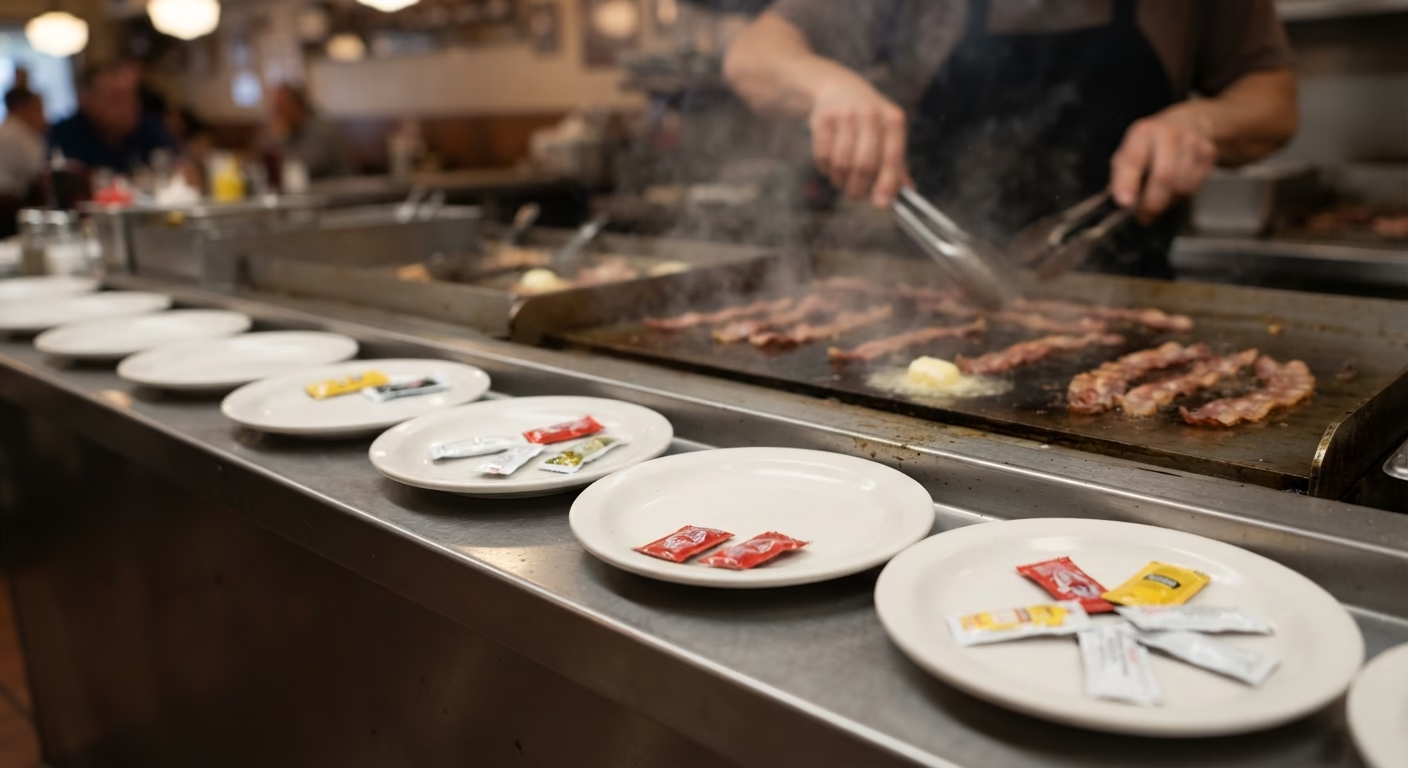
Watch a busy Waffle House grill for a few minutes and you’ll notice something odd: no screens, no printed tickets, and almost nothing written down. Yet a single cook keeps a dozen orders straight at once. The secret is the Waffle House marking system, a plate-based code that the company has described as hidden in plain sight.
How the System Works in Three Steps
Every order is called and tracked with the same three-part routine, often called pull, drop, mark.
- Pull. The server calls out the meats first, like “pull one bacon, pull two sausage.” The cook pulls them from the cooler and starts them on the grill, since meat takes the longest.
- Drop. Next the server calls the hash browns, like “drop three hashbrowns.” The cook drops that many portions on the grill.
- Mark. Finally, the server calls the rest of the order, and the cook “marks” a plate for each one so nothing is forgotten.
What “Marking” a Plate Means
Instead of writing on a ticket, the cook sets out an empty plate for each order and places small items on it in specific spots. Each item and position stands for part of the order. Reports from former employees and news outlets describe markers like these:
- Jelly packet at the bottom of the plate: scrambled eggs
- Jelly packet near the top: eggs sunny side up
- Other egg styles: shown by placing the packet in different positions around the plate
- Mayonnaise packet: used to show how soft or hard scrambled eggs should be, depending on which side faces up
- Mustard packet: combined with a jelly packet to signal extras, like an added egg or an omelet with ham
- Cheese slice on the plate: cheese on an omelet or hash browns
- Napkin on the plate: grits served in a bowl
Exact details can vary a bit between locations and over the years, but the idea stays the same: the plate itself becomes the ticket.
Why Waffle House Uses It
- It’s fast. A cook can glance down a row of plates and see every order at once, with no reading.
- It’s reliable. There’s no printer to jam and no screen to fail, which matters for a chain that stays open through storms and power outages (see the Waffle House Index).
- It keeps the order in sequence. Plates line up in the order they were called, so food goes out first-in, first-out.
- It’s easy to train. Waffle House says the system is simple to learn on the job, even though it looks like magic from the counter.
How to Watch It Yourself
Sit at the counter, especially during a weekend breakfast rush or late at night. Listen for the server’s call, then watch the cook set down plates and packets. Within a few orders you’ll start to recognize the pattern.
Want to understand the words you’ll hear? Our Waffle House lingo guide explains scattered, smothered, covered, and every other term.
How It Helps You Order Better
Because the system runs in a set sequence, it helps to give your order the same way: main item, egg style, meat, side, then bread. For example: “All-Star, eggs scrambled, bacon, hash browns scattered and covered, wheat toast.” That makes your server’s call cleaner and your plate more likely to come out exactly right. See what comes on the All-Star Special.
Frequently Asked Questions
Do Waffle House cooks really not use tickets?
For the grill, orders are called out loud and tracked on plates. Your check is still written up for payment.
What does “pull, drop, mark” mean?
Pull means start the meats, drop means put the hash browns on the grill, and mark means set up a plate that shows the rest of the order.
Is the marking system the same at every Waffle House?
The basic routine is the same chain-wide, though small details can differ between stores.
Is the Waffle House menu the same all day?
Yes. The full menu is served 24/7. Browse the complete Waffle House menu.